The Urgency of AI Transformation
“AGI will arrive in three years, yet most CEOs are still stuck in the outdated mindset of ‘automating current manual tasks’, wasting their last opportunities.”
Danilo McGarry, who has managed 3,500 “digital employees” and created $2 billion in measurable value for Citigroup and UnitedHealth, speaks with a calmness that belies the urgency of his message. He embodies a pragmatic approach, detesting illusions while maintaining a brutally honest view of the future.
In his perspective, the current business landscape is in a bizarre state of weightlessness. For the first time in human history, technology has far outpaced human imagination. While OpenAI’s “Ultramen” discuss changing the fate of species, CEOs of Fortune 500 companies are stuck in an “AI purgatory”—overstating achievements in board meetings to soothe shareholder anxiety while using cutting-edge engines to drive outdated processes, repeating mundane tasks from five years ago.
“We are less than 1,000 days away from AGI (Artificial General Intelligence), and that is 100% certain,” Danilo asserts. “If you haven’t started reconfiguring your company now, you’re already off the survival list.”
This sense of urgency transcends time zones and screens. Although Danilo cannot disclose specific client cases due to confidentiality, he provides a more ambitious framework aimed at helping businesses pierce through illusions and reclaim “interpretation rights” before superintelligence arrives.
The Collective Slumber in the Bubble
Huxiu Think Tank: You have recently mentioned the “AI bubble” in various forums. As someone immersed in it, how does your perception of the bubble differ from the general discussion?
Danilo McGarry: The current bubble is supported by three dimensions of exaggeration. First, shareholders are pressuring executives to use AI more and demand to see results. Consequently, every company and competitor exaggerates its AI achievements. Second, AI companies are also raising product expectations to attract attention and funding.
What disappoints me most is that even within Fortune 500 companies, leaders lack imagination. This is the first time in history that technology is ahead of human capability, yet we are not using superintelligence to do great things; instead, we are repeating boring tasks from five years ago. Everyone pretends to be busy and innovative, but it feels more like a collective “slumber”.
Huxiu Think Tank: How do you view China’s position in this “slumber” competition?
Danilo McGarry: I see a very clear misalignment. The U.S. has stronger foundational models, which is the “brain”; however, China demonstrates remarkable power in the application layer of AI innovation, capable of rapid deployment. This competition between “brain” and “execution” will determine who exits the lab first.
But regardless of location, the biggest common issue is that most companies only allow AI to occur in scattered areas, including some of the smartest companies on the planet.
AI Strategy: Treat Projects Like Post-Investment Management
Huxiu Think Tank: Is this “scattered occurrence” due to a lack of strategy?
Danilo McGarry: Exactly, it’s completely unstrategic. Many CEOs think that buying a tool and hiring a few PhDs equates to AI transformation.
A real AI strategy requires a very strict governance structure. For instance, if an employee comes to me requesting $10 million for an AI project, under old logic, I might approve it all at once. But in the AI era, that absolutely cannot happen.
You should allocate funds in phases like a venture capitalist. Start with $500,000 for validation to prove the logic works, then give $2 million, and finally the full amount. AI moves too fast; you must monitor results quarterly, just like an investor would with a startup. Just because it’s AI doesn’t mean we should abandon decades of project management principles; we just need to adapt them to a faster pace.
Huxiu Think Tank: Why do many large companies fail to scale their pilot projects?
Danilo McGarry: This touches on human psychology. Those “innovators” or “initiators” often quickly lose interest in a project. They enjoy the sprint from 0 to 1, but when it comes to deploying the solution to thousands of people, they lack the tedious, detailed skill set required.
To scale, you need a “Center of Excellence” and a specialized team of 20 to 50 people to manage it. Pilots can be completed by a few individuals, but transformation requires an army.
The reality is that everyone is trying but not really implementing anything because no committee dares to approve large budgets, and no team can handle that scale.
The 1,000-Day Countdown: A Race for Reconfiguration
Huxiu Think Tank: You repeatedly emphasize that “AGI is three years away”. What logic backs this prediction?
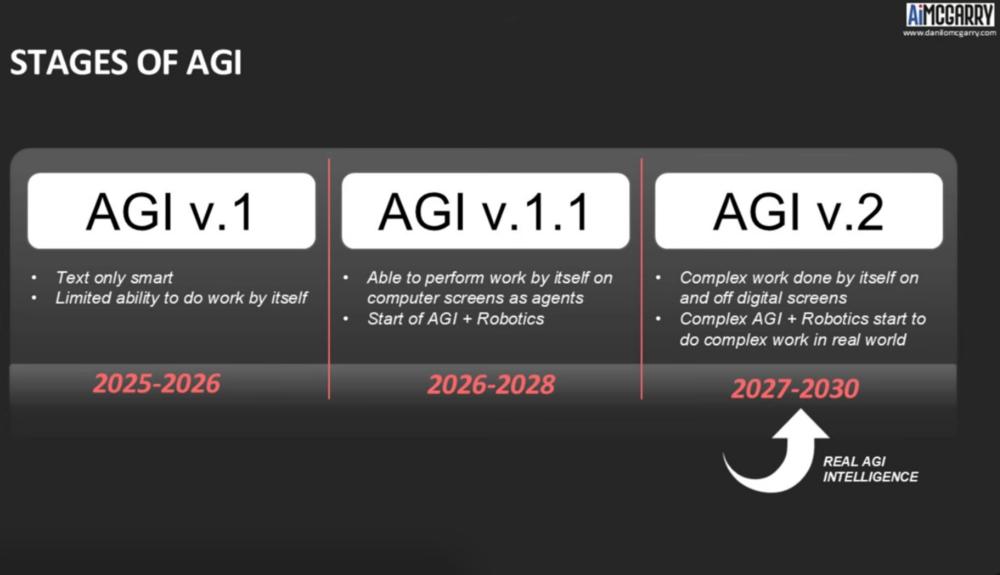
Danilo McGarry: AI has been around for 70 years, and there are currently about 120 “Narrow AIs”. I have participated in 12 of these, and these specialized capabilities are being integrated.
Next year, we may see the initial form of AGI. It will be like a textbook with perfect recall, capable of integrating all existing human knowledge and concepts. While it may not yet create new concepts, its breadth will surpass any individual human.
In 15 years, we might see ASI (Artificial Superintelligence), which could propose new methods and pathways never seen by humans. But the next three years (1,000 days) are decisive. Large and medium-sized enterprises require 2 to 4 years for complete transformation, meaning if AGI arrives in three years and your current progress is at zero, you will miss the boat.
Huxiu Think Tank: This sense of urgency doesn’t seem to have been conveyed to most CEOs?
Danilo McGarry: The biggest mistake many CEOs make is that they only let their teams automate “manual tasks currently happening today”.
What’s the point? You’re just making old mistakes happen faster. Leadership means everything. What you need to do is reconfigure the team and operational logic. If you can’t redefine workflows, you’re just using AI to polish mediocrity.
Huxiu Think Tank: Are you optimistic about the arrival of AGI?
Danilo McGarry: Cautiously optimistic. For the past century, humans have been working like robots, which is a waste of civilization. If AGI can take over those tedious tasks, allowing humans to regain creativity and genuine emotional connections, then the pain of these 1,000 days will be worth it.
Managing 3,500 Digital Employees and the Truth About Data
Huxiu Think Tank: You have managed 3,500 digital employees; what has that experience been like?
Danilo McGarry: AI agents excel at executing repetitive, manual tasks that require infinite memory. That’s a human weakness—our hands and memory are limited. Digital employees don’t get tired, but their errors can have catastrophic chain reactions.
Managing them isn’t about administrative orders but about an “Orchestration Layer”.
Huxiu Think Tank: What happens without this “Orchestration Layer”?
Danilo McGarry: It would be a disaster.
If you start having a large number of AI agents and robots without a centralized place for them to coordinate, their collaboration with humans will break down.
The orchestration layer acts like a control tower, defining new ways for humans and digital workers to work together. You need to understand exactly what people do every day, reimagine it, and translate it into a new blueprint locked into the process engine. The reason I can successfully manage such a large-scale automation is because of this orchestration layer.
Huxiu Think Tank: This sounds like a technical issue, but you keep saying it’s not about technology?
Danilo McGarry: It really isn’t a technical issue. The technology we have had for two years is sufficient to transform companies. The problem is that if you try to optimize 100 things at once, you will fail completely.
My advice is to pick the top 5 to 10 winning projects that can “unlock revenue”. Assemble a special team to nurture these projects like you would a child. Once these ten projects succeed, the profits and transformative power they generate will automatically push the remaining 90 projects forward.
Huxiu Think Tank: Data cleaning is often cited as the biggest obstacle for companies advancing AI. Many consulting firms say the same.
Danilo McGarry: That’s the biggest pitfall. I’ve seen hundreds of companies get stuck in endless projects because they “want to fix the data first”.
Data is a byproduct continuously flowing from poor old processes. If you don’t first establish the architecture for new processes, you will never finish cleaning it. Many consulting firms like to promote such projects because they are lengthy and expensive, but this stagnates businesses.
The correct logic is to design new processes that allow data to flow into the new architecture. In this process, old data will naturally be cleaned through logic and AI tools. Don’t let past dirty data delay your future new architecture.
The Collapse of Professions: From 800 to 100
Huxiu Think Tank: Regarding anxiety about unemployment, your analysis is very specific, mentioning 800 categories of professions.
Danilo McGarry: Our research shows that in the next five to seven years, the number of professions humans engage in will shrink from 800 to 100.
But this doesn’t mean 80% of jobs will disappear; rather, they will be “consolidated”.
The first category of jobs: completely repetitive. Those jobs where we used to treat people like robots will completely vanish, as the cost of robots drops below a critical point, and economies of scale will eliminate these positions.
The second category: jobs related to people, creativity, and strategy. These jobs won’t disappear but will be enhanced by AI by over 50%.
The third category: jobs protected by law. For example, judges, firefighters, and CEOs. These roles involve complex daily interactions and legal responsibilities that are difficult to replicate completely.
Huxiu Think Tank: What do you think is the most important skill during this transition period?
Danilo McGarry: Curiosity.
Sam Altman has mentioned this as well.
Curiosity lies at the heart of human psychology. Extreme optimism is dangerous; you make mistakes. Extreme pessimism is incapacitating; you don’t dare to try. Curiosity is “optimistic yet cautious”, “careful yet open”.
Curiosity drives your ability to “reimagine”. Reimagine your customers, your employees, your processes—this is your greatest weapon for personal growth and company development.
The Survival Rules for CEOs: Focus on Customers, Company, and Employees
Huxiu Think Tank: You never look at competitor analysis, which sounds incredible in modern business.
Danilo McGarry: Throughout my career, competitor analysis has never been a must-have. Even today, as I run three companies, this habit hasn’t changed. This isn’t arrogance; it’s because I am acutely aware of where my endpoint is. I know what variable leads to success, and as long as that variable is in my hands, my competitors’ actions lose reference value.
Huxiu Think Tank: So even failure cases don’t need attention?
Danilo McGarry: If you truly understand your customers and employees, you have no time or need to look at others. Real strategy shouldn’t look outward.
I’ve helped many international banks reform, and from an external perspective, these competitors appear to be doing almost the same thing in the capital market and financial reports. But when you delve into the internal workings, you find that each bank’s process architecture, decision-making mechanisms, and talent density are actually quite different.
This is a blind spot for many CEOs; they see a competitor signing an AI partnership to do something and rush to follow suit. But they fail to realize that due to fundamental operational differences, the same partnership may not apply to them at all.
Huxiu Think Tank: To what extent do most boards understand AI?
Danilo McGarry: Frankly, 80% of board members and C-level executives do not truly understand AI. This is why they cannot formulate strategies. I recommend that every company appoint someone on the board who genuinely understands transformation, AI, and the psychology of change.
Huxiu Think Tank: Your project success rate is 82%. Where did the remaining 18% go wrong?
Danilo McGarry: It comes down to “expectations”.
Technology can always do the job. But if you don’t set the right expectations from the beginning or lack data-supported logic, even if you complete half of the project with outstanding results, it will still be perceived as a failure. Perception is reality.
For example, if we predict a 400% improvement based on data, but greedy board members or shareholders say, “No, we want 2000%”, then when forced to accept an unrealistic goal, the seeds of failure are sown. Even if the project ultimately delivers an impressive 300% growth, it will still be viewed as a failure.
Huxiu Think Tank: People are always inclined to set higher goals. How do you define an “aggressive goal” that is still “good enough”?
Danilo McGarry: I discussed this with Elon Musk. We believe the golden rule for setting goals is that you need to ensure it has a 50% chance of being correct and a 50% chance of failure.
If a goal has an 80% success rate, it’s too conservative and not enough to change the way the company operates; if the success rate is too low, it jeopardizes the entire plan. Fifty percent is a delicate turning point; it’s scary enough to push the team to give their all to achieve it.
It’s like launching a rocket; your goal is Mars, and if the rocket encounters issues along the way, landing on the moon is still a great outcome. We should pursue aggressive goals that can create a significant impact even if we don’t achieve perfection.
The key is to support this 50% balance point with data and logic.
Huxiu Think Tank: When an AI project fails to meet expectations, how should a company decide whether to cut losses or continue investing?
Danilo McGarry: There’s a saying: even if you lose, you win.
In the AI field, very few people are true experts. A project that has run for six months, even if it fails, leaves behind invaluable “knowledge compound interest”. These lessons can prevent you from making the same mistakes next time; such profound experiences cannot be replaced by any external advice.
But to avoid making the lessons too costly, you need a mechanism:
- Phase Deliveries: Don’t try to go all in at once. If the first phase proves unworkable, you only lose 30% of the funds, not everything.
- High-Frequency Monitoring: Never wait a year to determine failure. You must monitor progress weekly or monthly.
- Dynamic Corrections: Our success rate of 82% comes from our ability to identify issues during monitoring and adjust promptly.
Huxiu Think Tank: Finally, can you give three scenario suggestions for CEOs who want to deploy “digital employees” but have limited resources?
Danilo McGarry: It varies by person.
If your marketing costs are too high, deploy AI-generated assets; if your financial closing is too slow, automate financial forecasting; if your operational administrative burden is too heavy, free up human resources.
Don’t chase “magic tools”; there are no shortcuts in six months. The true value of AI lies in your deep exploration of core business scenarios, especially those weaknesses you’ve always wanted to cover up, and transforming them into strengths.
Finally, accept the fact that your current business model will likely be worthless in three years.
Comments
Discussion is powered by Giscus (GitHub Discussions). Add
repo,repoID,category, andcategoryIDunder[params.comments.giscus]inhugo.tomlusing the values from the Giscus setup tool.